
St. Lucie County Court Records After a Jail Arrest
The path from an arrest to a court record runs through the prosecutor. After a St. Lucie County arrest, the person is booked into the jail with a set of booking offenses. Law-enforcement reports and the arrest affidavit then go to the State Attorney's Office for the 19th Judicial Circuit. The prosecutor reviews the arrest and decides what to file. That filing opens the formal court case, and the case is the court record. So the arrest starts the clock, but the court records begin when charges are filed.
Keep the two sides clear. The custody and booking detail lives on the jail roster, covered on the jail inmate records page, and booking photos are explained on the jail roster mugshots page. The court record is something else: the charges the prosecutor actually filed, the hearings, and the outcome. Booking charges and court charges do not always match, which is exactly why court records after an arrest are worth searching on their own.
How to Find St. Lucie County Court Records After an Arrest
The St. Lucie Clerk and Comptroller runs the court case search. The Clerk's public search hub links court cases, official records, pretrial status, and statewide tools. For charges after an arrest, the criminal case search is the path, and a name search is the realistic starting point when you do not yet have a case number.
The Benchmark court case search takes a name, case number, or citation number, with date ranges and court-type filters.
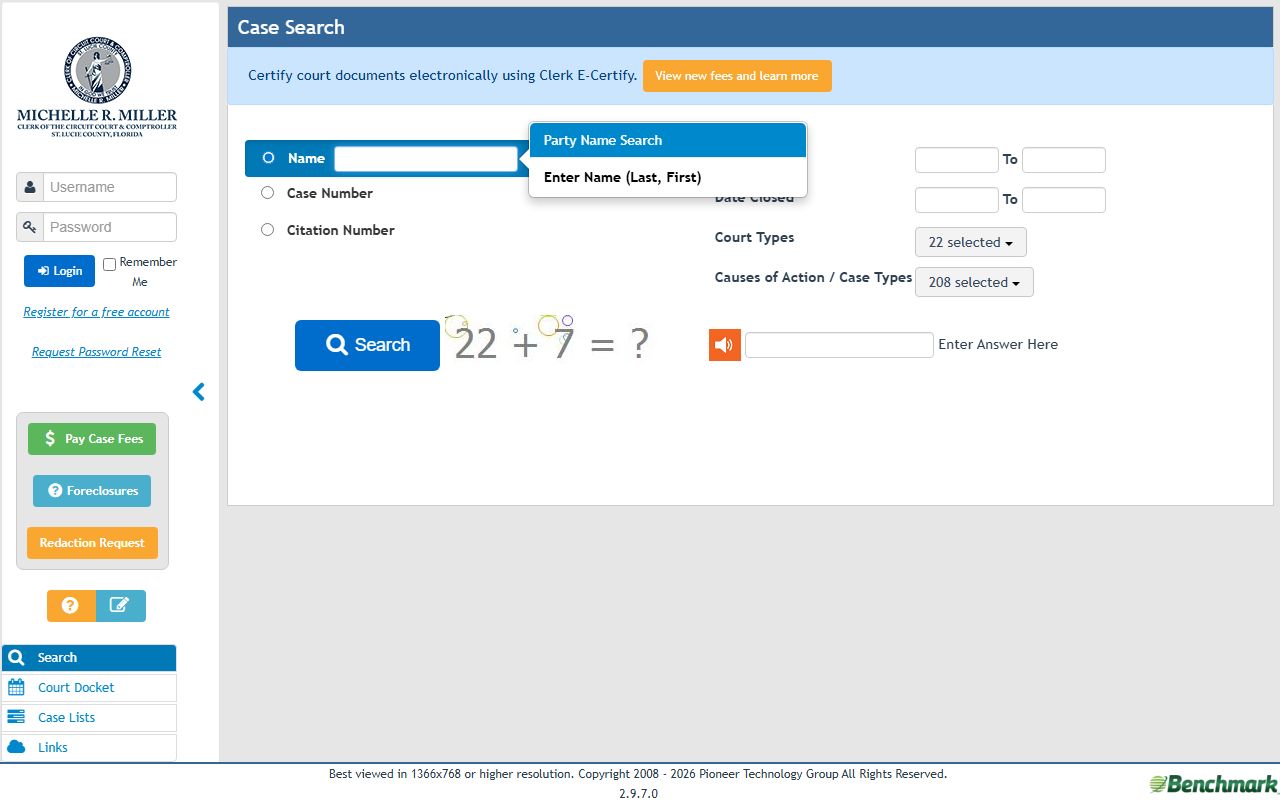
Once the search opens, the steps below walk from a name to the charge list for a specific case.
- Open the Clerk's court case search.
- Search by defendant name, entered as Last, First, or by case number.
- Clear the CAPTCHA and open the matching case.
- Read the charge list, the charge status, and the court dates.
The Clerk says the case search reaches most cases back to 1993, with parties, charges, and sentences viewable. A case number follows a format such as 2004TR000123, which is year, case type, then a six-digit number. For a broader check, the Clerk's statewide page links the FDLE criminal history search, which carries a $24 fee and is separate from the local court docket.
How Charges Get Filed After an Arrest: Complaint, Information, and Indictment
The court record starts with a charging document. After booking, the prosecutor decides whether and how to charge. In Florida, many cases proceed by Information, which is the document the State Attorney files. Serious felonies can go to a grand jury for an indictment. A complaint can begin lower-level matters. The prosecutor may also file No Information, meaning formal charges will not move forward on that arrest.
| Complaint | Information | Indictment | |
|---|---|---|---|
| Filed By | Officer or prosecutor | State Attorney | Grand Jury |
| Common For | Lower-level matters | Many felonies and misdemeanors | Serious felonies |
| Starts | The case | The case | The case |
The State Attorney's Office for the 19th Judicial Circuit serves St. Lucie, Indian River, Martin, and Okeechobee counties, and the current State Attorney is Thomas Bakkedahl. Because the prosecutor controls the filing, the charges in the court record can be broader, narrower, or different from the booking offenses listed at the jail.
Charge Status in St. Lucie County Court Records
Charges shift as a case moves. A charge can be amended, reduced, added, dropped, or dismissed. The booking charges from the arrest may not survive into the final filing, so the status field in the court record matters. The common terms are short, and knowing them keeps you from misreading a case.
| Status | What It Means |
|---|---|
| Pending | The charge or case has not yet been decided. |
| Amended / Reduced | The charge was changed after the first filing. |
| Dismissed | The court or prosecutor ended the charge. |
| Nolle Prosequi | The prosecutor dropped or abandoned the prosecution. |
Note: A booking charge on the jail roster is the jail's intake entry, while the court charge is what the prosecutor filed, so the two can differ on the same person.
Bond and Release After an Arrest
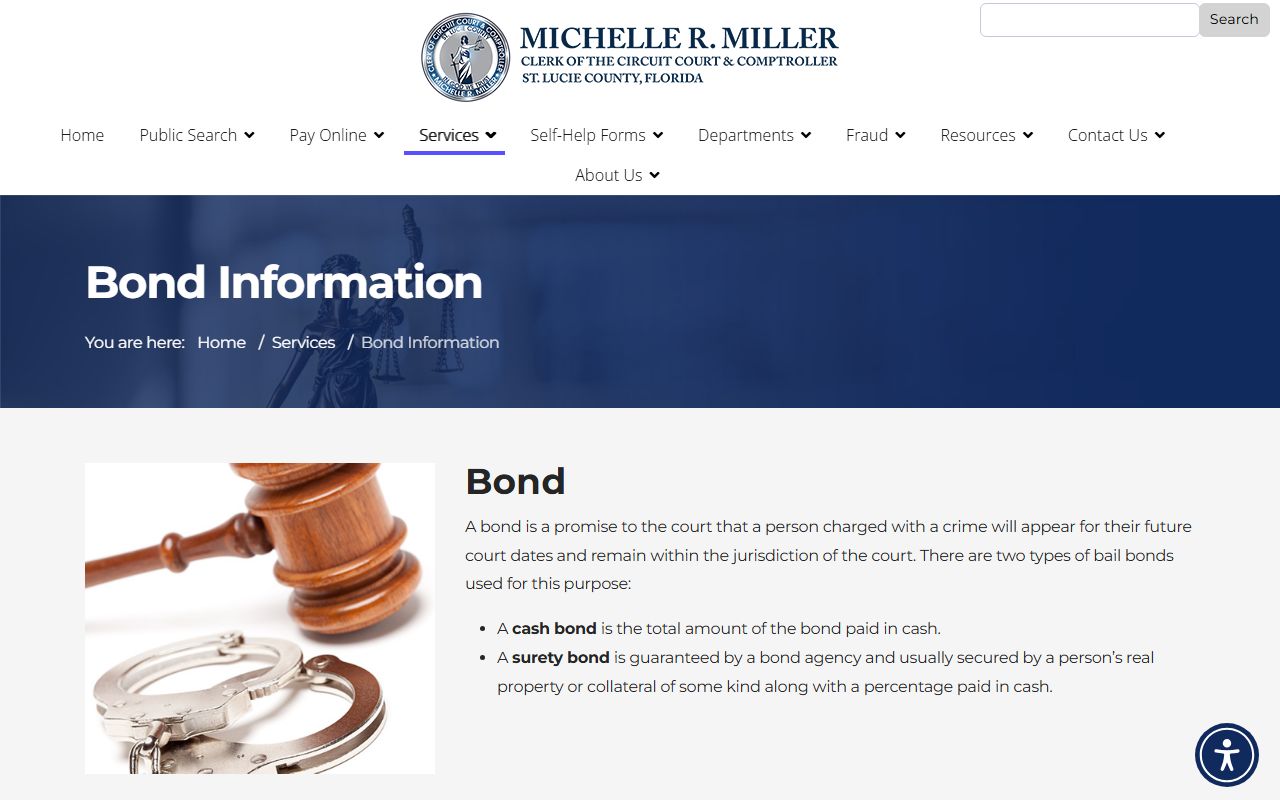
Bond is a promise that the person will appear in court and stay in the area. The St. Lucie Clerk explains two main types. A cash bond is the full amount paid in cash. A surety bond is guaranteed by a bond agency, usually with collateral plus a percentage fee. Bond can be set or changed at first appearance, and Florida pretrial detention and release follow state law. Some holds, such as another agency's warrant or an immigration detainer, can keep a person in custody even when a local bond looks payable.
The Clerk's bond information page covers cash and surety bonds, the cash bond refund, and bail bond agent registration.
After a case ends, a cash bond is refunded once unpaid court fees and costs are deducted, with refund checks mailed within 10 days of discharge and a completed request form.
| Bond Type | How It Works |
|---|---|
| Cash Bond | The full bond amount paid in cash to the court. |
| Surety Bond | Guaranteed by a licensed agency, usually with collateral and a fee. |
| Nonmonetary Release | Release on conditions without a full cash deposit, when allowed. |
| No-Bond Hold | Custody status where bond is unavailable until a court acts or a hold clears. |
Warrants That Lead to a St. Lucie County Arrest
A warrant can be the reason an arrest happens. When a judge signs an arrest or bench warrant, an officer can take the person into custody, and a booking at the county jail usually follows. The booking then appears on the Sheriff's roster. The court case docket can also show a bench warrant tied to a missed court date. No standalone Sheriff's online warrant list was found, so two public channels do the work.
- Search the Clerk's court case search for a case-linked bench warrant by defendant name.
- Use the FDLE Wanted Persons search for statewide wanted-person records cleared for public release.
FDLE warns the public not to take action and says its list should not be treated as proof that a warrant is active. For local verification, contact the Sheriff's Office directly. A Port St. Lucie Police contact page also lists a Sheriff's warrants line at 772-462-3247.
Charges vs. Convictions
An arrest and a charge are accusations. A conviction is an outcome. People often read a charge as guilt, but the court record keeps the two apart. A charge means the state believes there is enough to proceed. A conviction comes only after a plea or a verdict.
| Charge | Conviction | |
|---|---|---|
| Stage | Accusation | Verdict or plea |
| Burden of Proof | Probable cause | Beyond a reasonable doubt |
| Public Record | Yes | Yes |
Sealed vs. Expunged Court Records After an Arrest
Some records can be cleared after an eligible outcome. Sealing hides a record from general public view. Expunction goes further and orders the record removed or destroyed. In Florida, court-ordered expunction follows a specific statute, and it is a court process, not a website request. A dismissal or certain dispositions can make a case eligible, but the path runs through the court.
| Sealed | Expunged | |
|---|---|---|
| Visibility | Hidden from public view | Removed or destroyed |
| Law Enforcement | Limited access remains | Very limited access |
| Eligibility | Set by Florida law and the disposition | Set by Florida court-ordered expunction rules |
Requesting St. Lucie County Court Records and Arrest Affidavits
A search can show a case exists, but you may still need a copy of a document. The Clerk's research department handles requests for court and official records. Common document types include the arrest affidavit, the Information, a No Information, and a final judgment and sentence. The Clerk estimates 2 to 7 business days depending on availability and complexity, and quotes any fee before completing the work.
The Clerk's public records request form lists the court and official record types you can ask for.
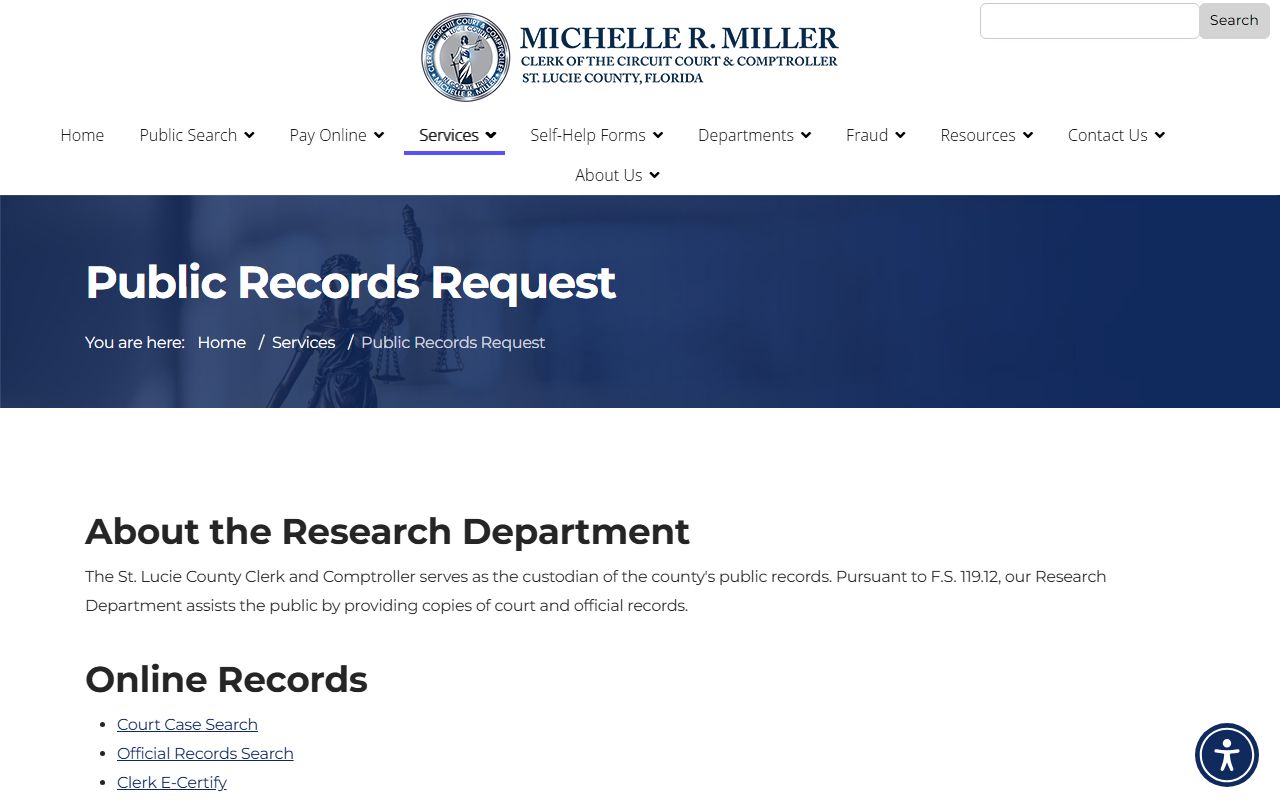
Route the request by who holds the record. The Clerk handles court filings, while the Sheriff handles booking and law-enforcement records through a separate portal.
Background Check Considerations
A casual court search is not a regulated background check. Formal screening for jobs, housing, credit, or insurance is governed by the Fair Credit Reporting Act and must come from a licensed consumer reporting agency. Court records you read for personal knowledge do not meet that standard.
Important: This site is not a consumer reporting agency under the FCRA, and nothing here may be used for employment, housing, credit, or insurance decisions.
Restricted Court Records After an Arrest in St. Lucie County
Not every record is fully open online. The Clerk notes that mental health, juvenile delinquency, and juvenile dependency cases are not viewable online. Sealed and expunged cases drop from public view. Some documents require a registered account, and redactions can apply under Florida access rules and court administrative orders. So a court search may confirm a case while still limiting the documents you can pull. For restricted or older material, the records request process is the next step.