
The St. Lucie County Inmate Population
The St. Lucie County inmate population lives mostly in one place. That place is the St. Lucie County Jail on North Rock Road in Fort Pierce. The St. Lucie County Sheriff's Office runs the jail through its Department of Detention. Sheriff Richard R. Del Toro Jr. leads the office. He was sworn in as the county's 13th sheriff in January 2025. The jail holds adults only. Youth and state prisoners are counted in separate systems.
How big is the count? Florida tracks it every month. The state's March 2026 county detention report listed an average daily population of 1,213 for the St. Lucie County jail. That figure is an average, not a live tally. The number rises and falls with arrests, bond decisions, court rulings, and transfers to state prison. When more people are booked than released, the St. Lucie County inmate population climbs. When cases close and inmates bond out or move on, it drops.
The jail is not the whole story. A state work-release center and a juvenile detention center also sit in the county. Those facilities hold different groups and use different records. The bulk of the adult St. Lucie County inmate population, though, is the jail roster you can search online.
St. Lucie County Inmate Population Statistics
The clearest current numbers come from the Florida Department of Corrections. Each month it publishes a county detention facilities report. The March 2026 edition listed the St. Lucie jail with an average daily population of 1,213 and an incarceration rate of 3.1 per 1,000 county residents. The same report put the jail at about 2.29% of Florida's total county detention population, which stood near 52,906 statewide.
Bed capacity comes from an older official source. The Sheriff's 2017 accreditation assessment reported a rated capacity of 1,370 beds after a 2005 expansion. Set the March 2026 average against that bed count and the jail sat near 88.5% full. Read every figure with its date attached, because the county count and the population base both change fast.
| Measure | Figure | Source / Year |
|---|---|---|
| Average daily population | 1,213 | Florida DOC, March 2026 |
| Rated bed capacity | 1,370 | FCAC assessment, 2017 |
| Annual jail admissions | 3,902 | Vera Institute, 2023 |
| Incarceration rate (per 1,000 residents) | 3.1 | Florida DOC, March 2026 |
| Pretrial share of the jail count | 64.8% | Florida DOC, March 2026 |
Note: The average daily population is a monthly mean reported by the state, not a head count of who is in the building at any single moment.
St. Lucie County Inmate Population Trends
The St. Lucie County inmate population has swung a good deal over the past several years. The Vera Institute's county series shows annual figures above the 1,370-bed mark in 2021 through 2024. That points to crowded years. The state's recent monthly reports tell a calmer story. The 2025 and early 2026 figures from Florida DOC all came in below the old bed count. So the jail looked tight a few years back and looser in the latest official months reviewed.
County growth sits behind the long view. The 2020 Census counted 329,226 residents. By July 2025 the Census estimate had reached 402,449. That is fast growth for a Florida county. More residents can mean more arrests over time, but the research does not tie any single year's jail count to that growth alone. Treat population growth as background, not as a direct cause.
| Year / Month | Average Daily Population | Notes |
|---|---|---|
| 2019 | 1,104 | Vera annual series; below the 1,370 capacity |
| 2021 | 1,632 | Vera annual series; above rated capacity |
| 2023 | 1,408.5 | Vera annual series; above rated capacity |
| Dec. 2023 | 1,343 | Florida DOC monthly; 65.2% pretrial |
| 2024 | 1,461 | Vera annual series; above rated capacity |
| June 2025 | 1,205 | Florida DOC monthly; 63.2% pretrial |
| Oct. 2025 | 1,173 | Florida DOC monthly; 65.0% pretrial |
| March 2026 | 1,213 | Florida DOC monthly; 64.8% pretrial |
Who Makes Up the St. Lucie County Inmate Population
Most people in the jail have not been convicted on the case that holds them. In March 2026 the state put the pretrial share at 64.8%. Pretrial means the case is open and the person is waiting on court action. They have not been found guilty of the pending charge. The felony group is much larger than the misdemeanor group, which tells you the jail is not just a short-stay population.
- Pretrial vs sentenced - 64.8% of the count was pretrial in March 2026, per Florida DOC.
- Felony vs misdemeanor pretrial - 670 felony pretrial against 116 misdemeanor pretrial in the March 2026 report.
- Male vs female - Vera's 2023 county data showed about 1,099 male and 180 female on average.
- Held for other agencies - Vera's 2023 data listed holds for federal authorities, U.S. Marshals, and a small ICE figure.
The state monthly reports do not break the county jail down by race or ethnicity. Vera's compiled county dataset does, but those are dataset values rather than a live Sheriff's dashboard. Use them as background and keep the year and source attached.
St. Lucie County Jail Capacity and Overcrowding
The jail's bed count grew in stages. The current Department of Detention opened in September 1987 and held 508 inmates across maximum, medium, and minimum security. The county added beds in 1990, 1993, and 2004. By 2004 the facility had a rated capacity of 794 but an average daily population of 1,184. That is 390 over the rated count, a clear crowding problem. Two new buildings finished in 2005 and pushed bed space to 1,370.
So has the crowding returned? It depends on the year and the source. Vera's annual figures for 2021 through 2024 ran above 1,370, which suggests strain in those years. The latest state monthly figures came in lower, with March 2026 near 88.5% of the bed count. The research found no new jail construction plan, court consent decree, or confirmed recent death-in-custody litigation in the official sources reviewed. Phrase any crowding claim with its year and its source so the picture stays honest.
Laws Governing the St. Lucie County Inmate Population
Florida law makes most jail and arrest information public, and it sets rules for how jails report their numbers. The Sheriff is named the county's chief correctional officer, and the state collects monthly jail population data. A few statutes do most of the work. Each one below has a short plain-English meaning so the reader knows why it matters.
Key Statutes:
Florida Statutes § 951.23 - Defines county detention facilities, adopts the Florida Model Jail Standards, and requires monthly jail-population reporting, which is where the county count comes from.
Florida Statutes § 951.061 - Lets the county designate the sheriff as chief correctional officer, who then runs and maintains the jail.
Florida Statutes § 119.011 - Defines public records and treats basic arrest facts, such as name, age, charge, and arrest time, as public.
Florida Statutes § 119.07 - Gives the public the right to inspect and copy nonexempt records and sets the fee rules.
Florida Statutes § 907.041 - Governs pretrial detention and release, which shapes who stays in the jail before trial.
St. Lucie County and the State Prison Population
Not every inmate stays in the county system. People convicted of felonies and sentenced to prison move into Florida Department of Corrections custody. That is a separate population with its own count and its own locator. A county criminal-justice profile reported about 1,842 St. Lucie inmates by county of commitment in the state prison system as of mid-2020, a far different measure than the daily jail count.
One state facility sits inside the county. The Fort Pierce Community Release Center is a Florida DOC community release site in Fort Pierce, not a county jail. It holds state inmates in work-release status. To find someone there, use the Florida DOC offender search rather than the Sheriff's roster. Mixing up the two systems is the most common search mistake in the county.
How to Search the St. Lucie County Inmate Population
The Sheriff's Office runs the official online roster for the county jail. You reach it from the Sheriff's Inmate Lookup page or go straight to the jail inmate search form. The search covers people in custody now and those released within the last five days. There is no login and no fee.
You need very little to start. A partial first or last name is enough. The form does not require both. A handy trick is built in for browsing.
The roster's search form is plain and fast, with a single name field set and a Search button.
The St. Lucie County jail inmate search form shows the name fields and the wildcard instruction.
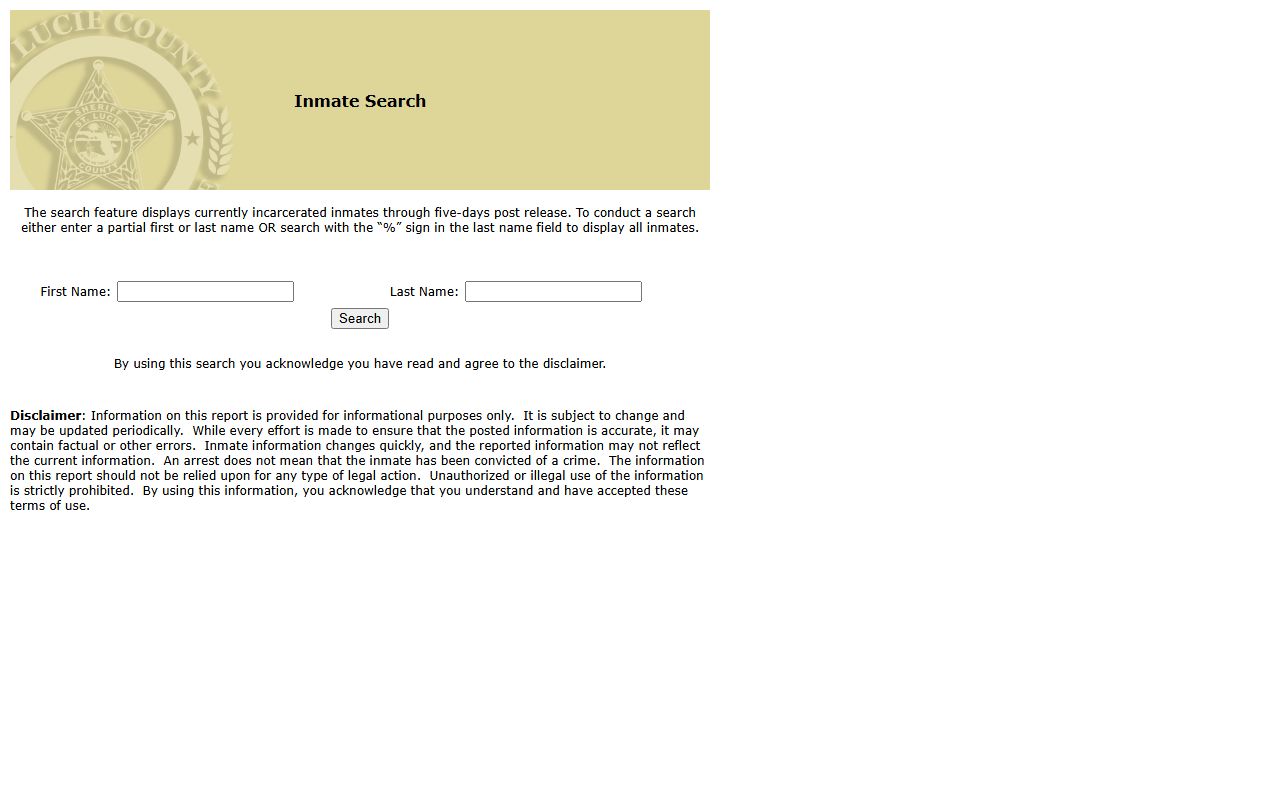
That same form is where every roster search starts, whether you look for one person or browse the full current list.
- Open the roster at the Sheriff's Inmate Lookup page or the direct jail search form.
- Type a partial first name or a partial last name. You do not need both.
- To browse everyone listed, type a percent sign in the Last Name field and submit.
- Click Search and review the results table.
- Click a name to open that person's profile for charges, bond, and housing.
- If the person was sentenced to prison, check the Florida DOC locator instead.
Current Inmate Lookup in St. Lucie County
A current lookup uses the same form. Enter a name and submit, and the system returns a table of matches. The columns cover Name, date of birth, age, inmate ID, booking date, and release date. When the release field is blank, the person is still in custody. When it holds a timestamp, the person left within the five-day window. You can sort the list by name, booking date, or release date. A full-list browse with the percent wildcard returned more than 1,100 records on a recent inspection, so it is a real way to scan the current St. Lucie County inmate population.
| Field Label | Type | Required | Notes |
|---|---|---|---|
| First Name | Text | No | Partial first name is accepted. |
| Last Name | Text | No | Partial last name works; a percent sign here lists all inmates. |
| Search | Button | n/a | Submits the name search. |
The public form has no booking-number field, no date-of-birth field, and no race or sex filter. Keep the search simple and lean on a partial name or the wildcard.
Past and Released Inmate Records
The roster is not built for old records. It shows current inmates plus anyone released in the past five days. A companion tool, the five-day release report, lists recent releases by name, date of birth, and release date. Use it when someone you saw on the roster has dropped out of current custody. For older booking records that are no longer online, file a public-records request with the Sheriff through the JustFOIA portal.
Released and sentenced inmates split into different systems. A person who bonded out or whose case closed simply falls off the roster after the five-day window. A person sentenced to state prison moves to the Florida DOC locator. The county roster never becomes a long-term history archive, so plan to use the records request or the state locator for anything past the recent window.
What a St. Lucie County Inmate Record Shows
Click a name and the profile opens. A St. Lucie inmate profile is custody-centered. It answers who holds the person, when they were booked, where they are housed, what booking offenses are listed, and what bond appears. It does not act as a court judgment, and it does not show statute numbers, case numbers, or court dates. The booking offenses are accusations at intake, not convictions.
The sample inmate profile layout shows the photo, booking detail, charges, bond, and the VINELink and TouchPay links.
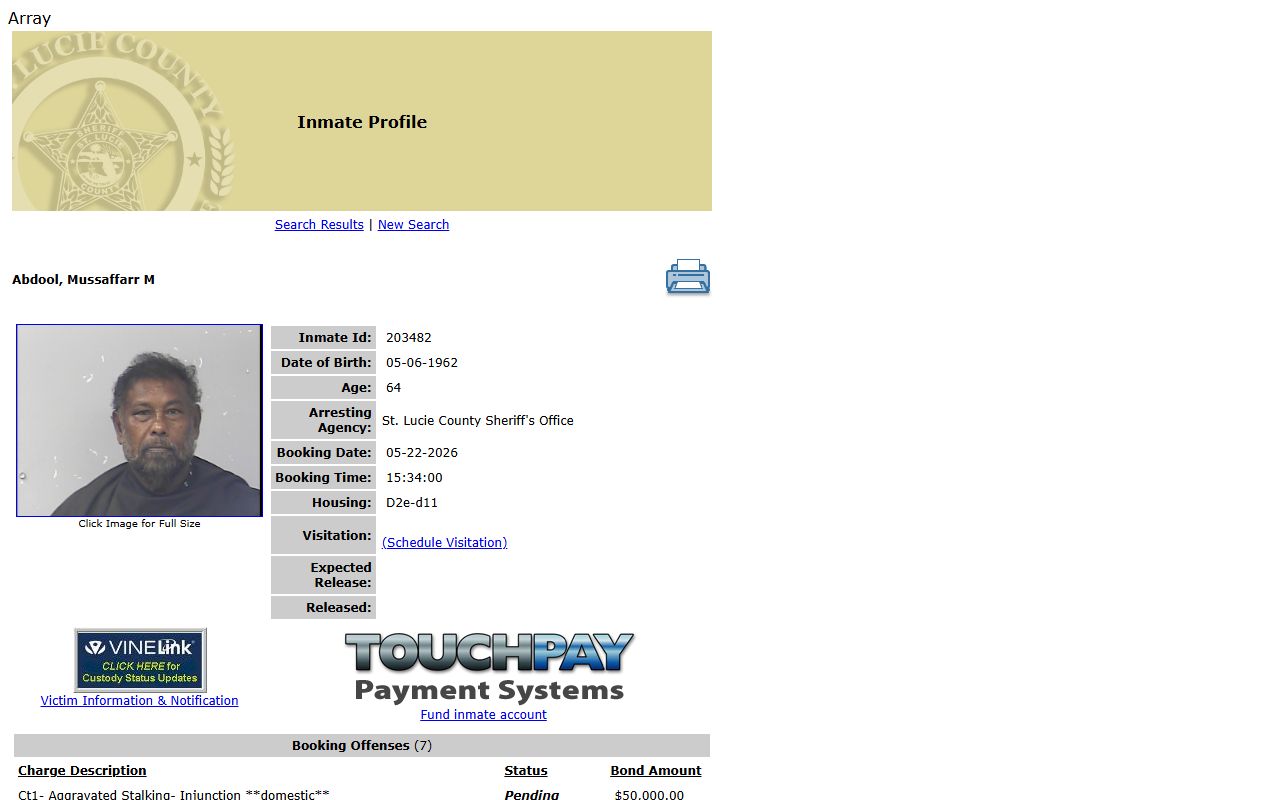
Each field on the profile maps to a clear piece of the booking record, as the table below lays out.
| Field | What It Shows |
|---|---|
| Inmate Id | The jail's numeric ID, used in the profile link, VINELink, and deposits. |
| Booking Date / Time | When the jail recorded the booking. |
| Booking Offenses | The charge descriptions listed at intake, with a count. |
| Bond Amount / Total Bond | The bond per charge and the total at the bottom of the table. |
| Housing | A compact internal housing code, such as a wing and cell label. |
| Released | Blank for current custody, or a timestamp for a recent release. |
Note: A booking shows charge descriptions, status, and bond, but not the statute numbers or court case number that the clerk's court record carries.
Custody Terms Used on the Roster
A roster uses words that trip people up. A short glossary helps you read a profile without guessing. These are the terms that come up most when you look at the St. Lucie County inmate population.
- Pretrial detainee
- A person held before the case is decided. They have not been convicted of the pending charge.
- Bond
- Money or a surety promise tied to the person's return to court.
- Hold or detainer
- A separate legal reason that can keep someone in custody even after a local bond is posted.
- Classification
- The jail process that assigns security level and housing, so a housing code can change after intake.
- VINELink
- A victim notification service linked from each profile that sends custody-status alerts.
County Jail vs. State Prison: Where to Look
Pretrial detainees and short-sentence inmates sit in the county jail. Sentenced felons move to a state prison run by the Florida Department of Corrections, which uses a different locator. Knowing which system holds the person saves a lot of failed searches. A county inmate ID and a state DC number are not the same identifier.
| County Jail | State Prison (DOC) | |
|---|---|---|
| Who Is Held | Pretrial and short sentences | Sentenced felons |
| Run By | St. Lucie County Sheriff | Florida Department of Corrections |
| Where to Look | County jail roster | Florida DOC offender search |
| Stays Listed | Current, plus five days after release | Through sentence and supervision |
State and Federal Inmate Search
Three more locators cover the rest of the picture. The Florida DOC offender search covers people sentenced to state prison or state supervision, and it excludes county jail inmates. The federal Bureau of Prisons locator covers federal inmates held from 1982 to the present. The ICE Online Detainee Locator covers people in immigration custody and excludes anyone under 18. No federal prison and no standalone ICE facility sits in St. Lucie County, so these matter only when federal or immigration custody is in play.
Victims and families can also set up alerts. Florida VINELink sends custody-status notices, and each county inmate profile links to it. Treat VINELink as notification support, not as proof that a person will stay in custody.
St. Lucie County Detention Facilities
Three detention facilities sit in the county, and each holds a different group. Only the first is searched through the Sheriff's roster. The other two use state systems. Pick the facility that fits the person you are trying to find.
- St. Lucie County Jail - adult pretrial and county-sentenced inmates, searched on the Sheriff's jail roster.
- Fort Pierce Community Release Center - state inmates in work-release custody, found through the Florida DOC offender search.
- St. Lucie Regional Juvenile Detention Center - detained youth handled by the Department of Juvenile Justice, not the adult roster.
St. Lucie County Inmate Population FAQ
How big is the St. Lucie County inmate population?
The Florida Department of Corrections listed an average daily population of 1,213 for the county jail in March 2026. That is a monthly average, not a live count. Against the jail's reported 1,370-bed capacity, the figure put the facility near 88.5% full. The number shifts with arrests, bond rulings, and transfers.
How do I search the St. Lucie County inmate population?
Use the Sheriff's online jail roster. Enter a partial first or last name and submit, or type a percent sign in the Last Name field to list everyone. The search covers current inmates and anyone released in the past five days. There is no login and no fee.
Can I look up a released or past inmate?
Recent releases stay on the roster for five days, and the release report lists them by name and date. Older booking records are not online. For those, file a public-records request with the Sheriff through the JustFOIA portal. A person sentenced to prison appears in the Florida DOC locator instead.
Are most people in the jail convicted?
No. In March 2026 about 64.8% of the count was pretrial, which means their cases were still open. They had not been found guilty of the pending charge. The felony pretrial group was far larger than the misdemeanor group.